Webinar video https://www.youtube.com/watch?v=QCuJouPVUIY
Presentation slides
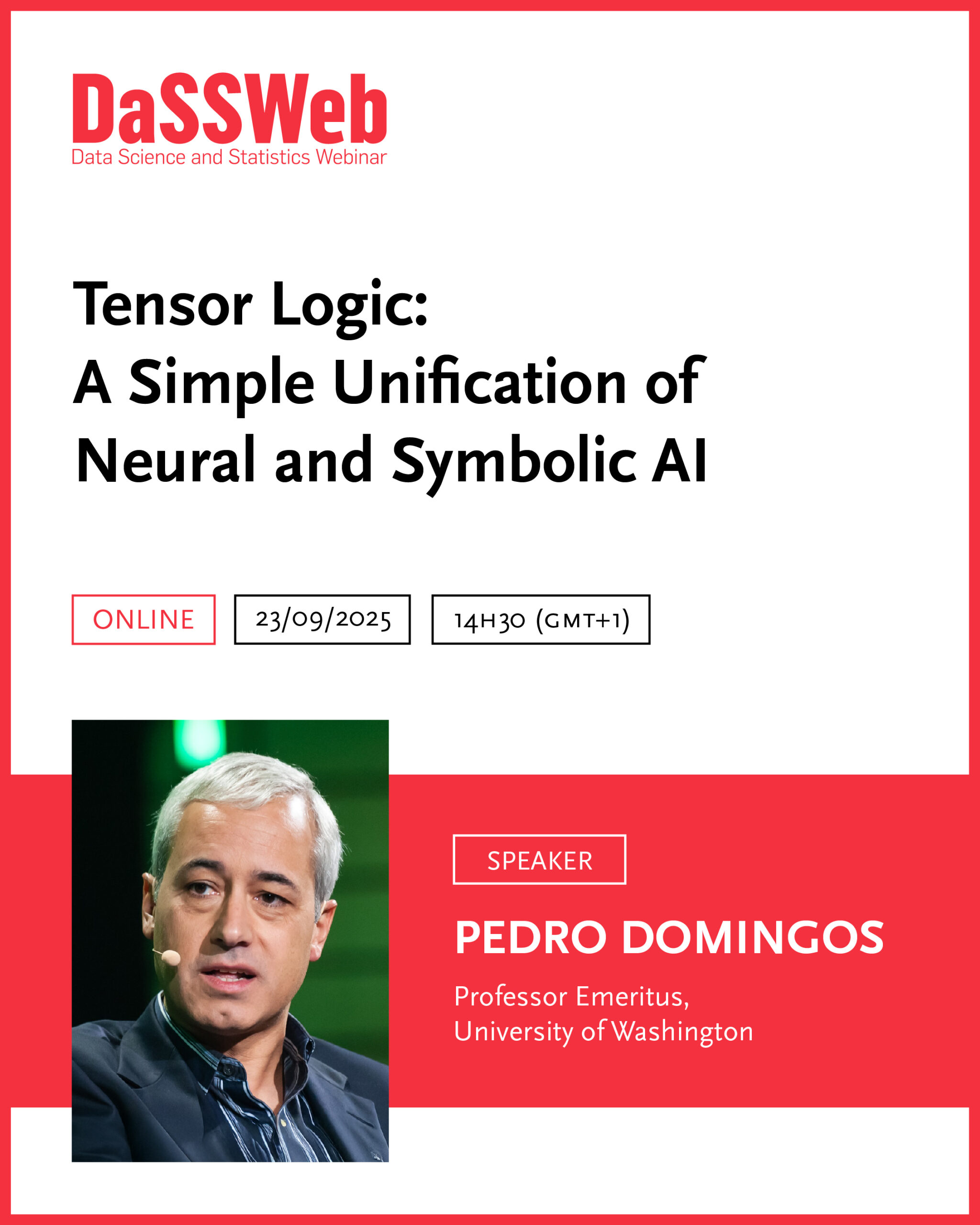
Abstract
Deep learning has achieved remarkable successes in language generation and other tasks, but is extremely opaque and notoriously unreliable. Both of these problems can be overcome by combining it with the sound reasoning and transparent knowledge representation capabilities of symbolic AI. Tensor logic accomplishes this by unifying tensor algebra and logic programming, the formal languages underlying respectively deep learning and symbolic AI. Tensor logic is based on the observation that predicates are compactly represented Boolean tensors, and can be straightforwardly extended to compactly represent numeric ones. The two key constructs in tensor logic are tensor join and project, numeric operations that generalize database join and project. A tensor logic program is a set of tensor equations, each expressing a tensor as a series of tensor joins, a tensor project, and a univariate nonlinearity applied elementwise. Tensor logic programs can succinctly encode most deep architectures and symbolic AI systems, and many new combinations. In this talk I will describe the foundations and main features of tensor logic, and present efficient inference and learning algorithms for it. A system based on tensor logic achieves state-of-the-art results on a suite of language and reasoning tasks. How tensor logic will fare on trillion-token corpora and associated tasks remains an open question.
Short Bio
Pedro Domingos is a professor of computer science at the University of Washington and the author of “The Master Algorithm” and “2040”. He is a winner of the SIGKDD Innovation Award and the IJCAI John McCarthy Award, two of the highest honors in data science and AI, and a Fellow of AAAS and AAAI. His research spans a wide variety of topics in machine learning, artificial intelligence, and data science. He helped start the fields of statistical relational AI, data stream mining, adversarial learning, machine learning for information integration, and influence maximization in social networks.
Information at FEP News
More information at News U. Porto